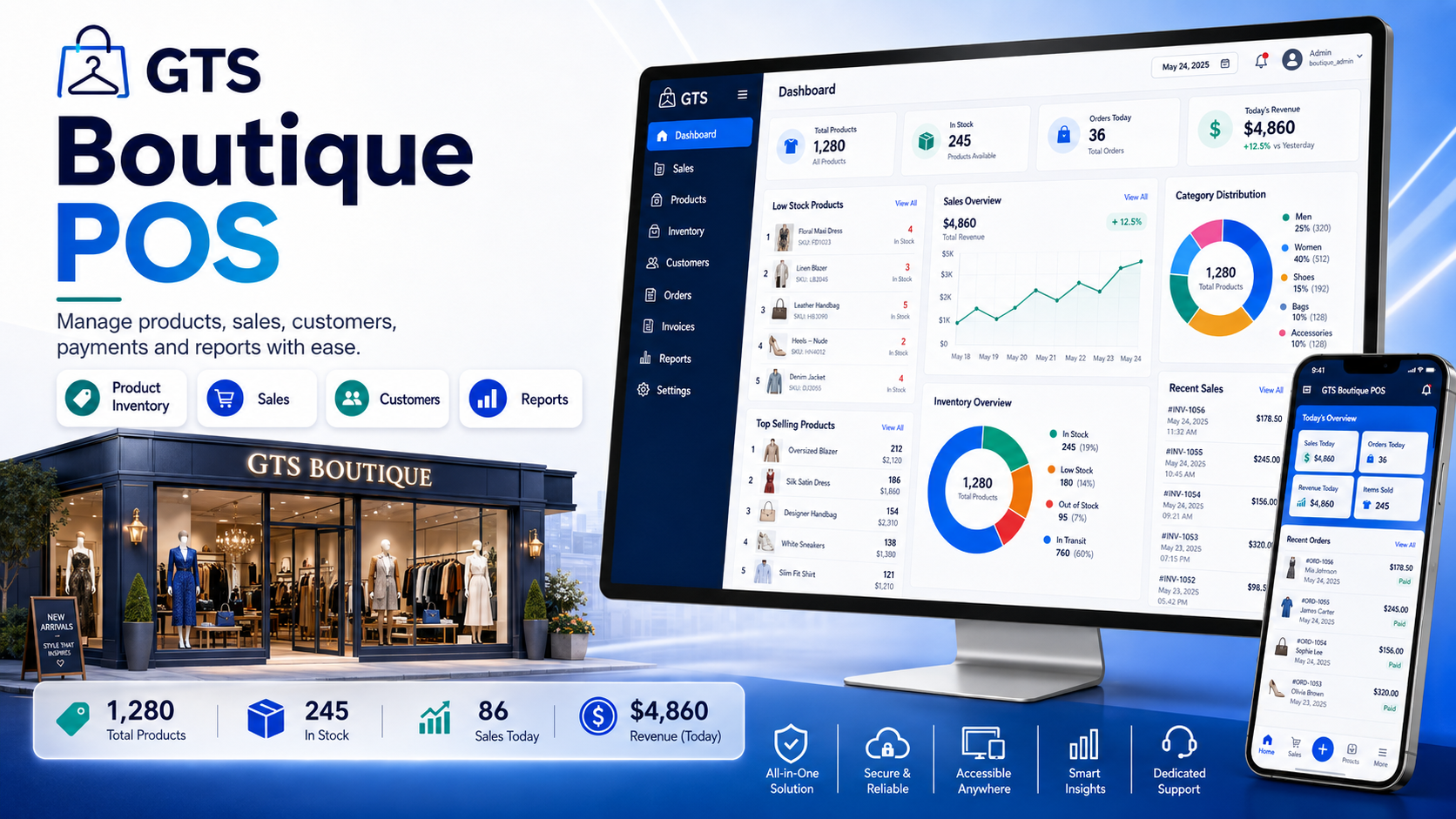
PRODUCT OVERVIEWSoftware designed around real work.
The GTS Multi-Purpose POS – Boutique Edition is a complete sales, inventory, customer, and business management solution designed specifically for fashion boutiques, clothing stores, shoe shops, accessories shops, fabric sellers, fashion outlets, and other retail businesses that deal with products in different sizes, colours, styles, brands, and categories.
It provides boutique owners with one central system to manage daily sales, stock, customers, staff, payments, expenses, reports, and business performance. Instead of relying on notebooks, spreadsheets, calculators, or disconnected applications, the Boutique POS brings the most important parts of the business together in a simple and organized platform.
Whether you operate a small boutique, a growing fashion shop, or multiple branches, the system is designed to help you maintain better control over your stock, understand what customers are buying, reduce losses, improve customer service, and make better business decisions.
Smart Product and Fashion Inventory Management
Boutiques often stock the same product in several variations. A single shirt, dress, pair of shoes, or trousers may come in different colours, sizes, designs, brands, and price ranges.
The Boutique POS makes it easier to organize these products properly so staff can quickly identify the exact item being sold.
Products can be grouped into categories such as men's clothing, women's clothing, children's wear, shoes, bags, jewellery, watches, fabrics, cosmetics, accessories, and other fashion products.
Product records can contain information such as product name, barcode or item number, category, supplier, cost price, retail price, wholesale price, available quantity, reorder level, description, and other relevant product details.
This helps the boutique maintain accurate records while making products easier to search, sell, and manage.
Size, Colour and Product Variation Management
Fashion businesses depend heavily on product variations.
The Boutique POS can be configured to manage products according to characteristics such as size, colour, style, brand, design, material, gender, collection, or other attributes used by the business.
For example, the same T-shirt can be available as Small, Medium, Large, and Extra Large, while also being available in black, white, blue, red, or other colours.
This makes inventory management more accurate because the business can identify which specific variations are selling and which ones remain in stock.
Fast Point-of-Sale Checkout
The sales interface is designed to help attendants complete customer transactions quickly.
Staff can search for products, scan barcodes using supported barcode scanners or camera-based barcode functionality, add items to the sales register, adjust quantities where permitted, apply approved discounts, select payment options, and complete the transaction.
A receipt can then be generated for the customer.
The faster checkout process helps reduce queues and makes it easier for staff to serve customers during busy shopping periods.
Barcode and Camera Scanning
Products can be assigned barcodes or item numbers for easier identification.
Where supported, the system can also use a device camera to scan product barcodes, allowing boutiques to operate with compatible phones, tablets, laptops, or desktop devices without depending entirely on dedicated barcode scanners.
This can be particularly useful for smaller boutiques or businesses looking for a flexible and affordable POS setup.
Real-Time Stock Control
Every sale can automatically update available stock.
This gives boutique owners a clearer picture of what is currently available instead of depending on manual stock counting after every sale.
The system can also help identify products that have reached their reorder level so the business can restock popular items before they run out.
This is especially important in fashion retail, where popular colours, sizes, designs, and seasonal products can sell quickly.
Low-Stock and Reorder Management
The system allows businesses to establish reorder levels for products.
When stock reaches the specified level, management can identify items that need replenishment.
This reduces the risk of losing customers because a popular size, colour, shoe type, dress, shirt, bag, or accessory is unavailable.
It also helps prevent unnecessary overstocking of slow-moving products.
Supplier Management
Boutiques normally purchase products from several suppliers, wholesalers, importers, manufacturers, or distributors.
The Boutique POS allows businesses to maintain supplier information and associate products with relevant suppliers.
This makes it easier to understand where products were sourced and supports better stock purchasing and supplier management.
Cost, Retail and Wholesale Pricing
The system can record product cost prices together with retail and wholesale prices where applicable.
This allows businesses that sell both directly to individual customers and to resellers to manage different pricing structures within the same system.
Having accurate cost and selling prices also improves profit reporting and helps management understand the actual performance of products.
Customer Management
The Boutique POS can help the business maintain customer information and sales history.
Instead of treating every transaction as an isolated sale, the boutique can gradually build stronger relationships with returning customers.
Customer records can support personalised service, loyalty initiatives, targeted promotions, marketing campaigns, purchase-history analysis, and other customer-retention activities.
For example, a boutique may identify customers who frequently purchase dresses, shoes, men's clothing, or particular brands and communicate relevant offers to them.
Customer Loyalty and Marketing
The Boutique POS can support loyalty and customer marketing activities that encourage repeat purchases.
Boutiques can use available customer and transaction information to understand customer behaviour and develop promotions around new arrivals, seasonal collections, clearance sales, customer rewards, special discounts, and other campaigns.
This turns the POS from simply a payment system into a tool for growing customer relationships.
Discounts and Promotional Sales
Fashion retail businesses frequently run promotions.
The Boutique POS can support authorized discounts during activities such as clearance sales, festive promotions, customer rewards, seasonal offers, new collection launches, or special campaigns.
Properly recording discounts within the system provides better accountability than manually changing prices without keeping transaction records.
Multiple Payment Options
The Boutique POS can support different payment methods based on the configuration of the business.
Customers may therefore complete purchases using supported methods such as cash, mobile money, card, bank-related payments, or other integrated payment options where available.
Recording the actual payment method also helps management understand how customers prefer to pay and simplifies daily financial reconciliation.
Sales Receipts
After a successful transaction, the system can generate a sales receipt containing relevant transaction information.
This provides customers with proof of purchase and gives the boutique a reliable record of the transaction.
Receipts are also useful when the boutique operates exchange, return, or customer-service policies.
Returns and Sales Accountability
Proper transaction records make it easier for management to investigate customer complaints, product returns, exchanges, incorrect sales, or transaction adjustments.
Instead of relying entirely on an employee's memory, management can review transaction records to understand what was sold, when it was sold, the amount charged, and which staff member handled the transaction.
Staff Accounts and Access Control
Different staff members can be provided with individual user accounts and appropriate levels of access.
A cashier, salesperson, stock controller, manager, or administrator does not necessarily need access to every part of the system.
Role-based access can help protect sensitive information while ensuring employees have access to the functions required for their responsibilities.
Staff Performance Monitoring
Management can review sales activities associated with staff accounts.
This can help identify staff members generating significant sales, understand sales activity during different shifts, improve accountability, and support staff-performance evaluation.
For boutiques that operate commission-based sales structures, reliable sales records can also provide useful information for calculating employee performance.
Expense Management
Running a boutique involves expenses beyond purchasing stock.
Businesses may need to track transport costs, packaging, electricity, delivery charges, marketing expenses, shop maintenance, employee-related costs, or other operational expenses.
Recording expenses alongside sales provides management with a more realistic view of business performance.
Sales and Business Reports
The Boutique POS provides management with reports that help transform transaction data into useful business information.
Depending on the configuration, reports can help answer important questions such as which products are selling most, which products are moving slowly, how much revenue was generated during a particular period, which staff members recorded sales, which categories perform well, and how current stock levels compare with sales activity.
These insights help management make decisions based on actual business data instead of guesswork.
Best-Selling and Slow-Moving Products
Fashion trends can change quickly.
The Boutique POS helps businesses identify products attracting strong customer demand and products that remain unsold for longer periods.
Management can use this information when deciding what to reorder, what to reduce, what to promote, and what not to purchase again in large quantities.
For example, the system may help reveal that a particular shoe size sells faster than others or that one dress design performs significantly better than another.
Profit and Performance Analysis
By combining selling prices, product costs, sales records, and other available financial information, management can gain a clearer understanding of business performance.
This helps boutique owners move beyond looking only at total sales and begin evaluating whether products, categories, branches, or periods are actually generating healthy returns.
Owner and Management Dashboard
Business owners can use the management dashboard to monitor important activities without manually checking every transaction.
The dashboard provides a convenient overview of key areas of the business such as sales, inventory, customers, staff activities, and other operational indicators supported by the system.
This is particularly useful for owners who are not always physically present at the shop.
Audit and Fraud-Control Support
Because transactions and system activities can be recorded under individual user accounts, management has better visibility into what happens inside the business.
This can help identify unusual transactions, unauthorized adjustments, suspicious discounts, stock inconsistencies, or other activities that require investigation.
Improved transaction accountability can reduce opportunities for internal losses and make it easier to trace problems when they occur.
Multi-Branch Support
Boutiques operating more than one location can use the GTS Multi-Purpose POS to improve oversight across their branches, depending on the selected deployment and configuration.
Management can monitor business activities across locations while maintaining more organized records for stock and sales.
This provides growing fashion businesses with a system capable of supporting expansion.
Online Orders and Digital Sales
Where online-order functionality is enabled, the Boutique POS can support businesses receiving customer orders through digital channels.
This is useful for boutiques that promote products through websites, social media, WhatsApp, or other online platforms while still needing proper sales and inventory records.
Online and physical sales can therefore form part of a more coordinated business-management process.
Data Backup and Business Continuity
Business records are valuable assets.
The GTS Multi-Purpose POS includes data-management and backup capabilities designed to reduce the risk of losing important operational information.
Maintaining reliable business records gives owners greater confidence when reviewing historical sales, customer activity, inventory movement, and other transactions.
Suitable Businesses
The Boutique POS can be adapted for businesses including:
Fashion boutiques
Clothing stores
Men's fashion shops
Women's fashion shops
Children's clothing stores
Shoe shops
Bag and accessories stores
Jewellery shops
Watch shops
Fabric and textile stores
Bridal and occasion-wear stores
Uniform and clothing retailers
Fashion wholesalers and retailers
Cosmetics and fashion-accessory outlets
Multi-branch fashion businesses
Why Choose GTS Multi-Purpose POS for Your Boutique?
The GTS Boutique POS is more than a cash register.
It provides a structured system for managing the complete sales journey — from purchasing and stocking products to selling them, managing customers, monitoring employees, reviewing reports, and making decisions about the future of the business.
Its flexibility makes it suitable for both small boutique owners who want to move away from manual record keeping and established fashion businesses that require stronger inventory control, reporting, staff accountability, and management oversight.
With better information about what is selling, what remains in stock, what customers prefer, and how the business is performing, boutique owners can reduce avoidable losses and concentrate on growing the business.
GTS Multi-Purpose POS – One System for Your Boutique
With the GTS Multi-Purpose POS – Boutique Edition, you can manage your sales, stock, customers, staff, suppliers, payments, expenses, reports, and business performance from one organized platform.
It gives your boutique the digital tools needed to operate more professionally, serve customers faster, keep better records, understand your business, and prepare for growth.
Sell smarter. Control your stock. Understand your customers. Grow your boutique with GTS Multi-Purpose POS.